What’s cooking, Mediterranean? | On 16 November 2026, the Mediterranean Diet will have its own international day, a first, following a United Nations General Assembly decision last December. It is a recognition that goes beyond nutrition: the Mediterranean way of eating is now officially acknowledged as a public health model, an environmental asset, and a piece of living cultural heritage protected by UNESCO.
Across the Mediterranean, traditional food habits are giving way to ultra-processed alternatives. Urbanisation, time pressure, and shifting lifestyles have made convenience the default, at a cost to both individual health and environmental sustainability.
The diet that researchers, doctors, and international bodies have spent decades praising is, paradoxically, disappearing from the plates of the people who invented it.
It is precisely this contradiction that PRIMA set out to address. In 2025, PRIMA launched a dedicated funding call “Transforming Mediterranean Food Systems: Empowering Consumers for Sustainable Diets” targeting the gap between what we know about the Mediterranean diet and what people actually eat.
Four projects were selected.
Building upon tools and best practices developed in previous PRIMA projects, each initiative brings its own approach: PANACEA draws on the MEDIET4ALL platform, while SchoolMedDiet builds on the SwitchToHealthy app. More broadly, all four projects rely on data, methodologies, and lessons learned from past research efforts, ensuring that new work does not start from scratch, but rather advances what the Mediterranean research community has already achieved..
We are now welcoming these 4 new projects, who use virtual reality, living labs, and citizen science. They all start from the same premise: information alone does not change behaviour. Change requires meeting people where they live.
Meet MED4CITRUS, PANACEA, SchoolMedDiet and SHADES. Here is what they are building:
MED4CITRUS: Reviving Hippocratic Wisdom through the Mediterranean Diet Promoting citrus consumption for health and sustainability via living labs and digital tools
Hippocratic wisdom rests on a simple idea: food is medicine. What we eat shapes our health, making diet a tool for prevention, not just pleasure.
The problem: Rising chronic diseases, nutritional imbalances, and ultra-processed food consumption, set against growing environmental pressures.
The solution: Rediscovering Hippocratic wisdom by making Mediterranean citrus the symbol of preventive, sustainable, and locally rooted eating.
What if food were medicine? MED4CITRUS brings this ancient idea into the modern world.
Across 8 Mediterranean countries, it will deploy living labs, digital games, virtual reality, and citizen science tools to promote the consumption of citrus which is rich in antioxidants and nutraceuticals,among children, youth, and older adults. Change is co-created by researchers, farmers, health professionals, educators, and citizens through a multi-actor model grounded in local realities.
Why it matters: Where most health campaigns rely on top-down messaging, MED4CITRUS bets on lived experience, play, and participation, connecting citrus biodiversity, the Mediterranean diet, digital innovation, and public policy into a coherent chain, from orchard to plate, from classroom to institution.
The expected impact: Citrus-based circular products, educational packages for healthy eating habits, and a replicable living lab methodology guide. At scale, MED4CITRUS aims to shift dietary behaviours durably, strengthen local agricultural value chains, protect citrus biodiversity, and influence food policy across the communities involved.
MED4CITRUS is Led by the Olive Tree, Subtropical Trees and Viticulture InstituteELGO-DIMITRA (Ellinikos Georgikos Organismos – DIMITRA) – Greece
PANACEA: Helping Mediterranean families adopt healthy, sustainable diets during pregnancy and the first 1,000 days
The problem: The window from pregnancy to early childhood is nutritionally critical, yet families face real barriers to eating well: time, cost, skills, access, and lack of social support. Poor habits formed in this period can shape health outcomes for generations.
The solution: Meeting families where they are, with digital coaching, community workshops, peer networks, and farm-to-fork food access, to make the Mediterranean Diet the natural choice during pregnancy and early parenthood.
The first 1,000 days, from conception to early childhood, have a lasting impact on lifelong health. PANACEA will build a community-level safety net around pregnant women and their partners, combining an AI-powered dietary coach, culturally tailored cooking workshops, a gamified rewards system, and direct links to local and seasonal food producers. Rather than telling families what to eat, it removes the obstacles that stop them from eating well, through co-created living labs that reflect each community’s own culture and constraints.
Why it matters: Nutrition during pregnancy and early childhood sets the template for lifelong eating habits. PANACEA acts at exactly the right moment, harnessing the motivation that comes with parenthood to build habits that stick. By strengthening short food supply chains and measuring the carbon, water, and land footprint of diets, it also connects individual choices to planetary boundaries.
The expected impact: Around 1,000 participants will benefit from a 10-month intervention measurably increasing Mediterranean Diet adherence and food literacy. Beyond individual outcomes, PANACEA will deliver policy-ready recommendations for public procurement, a replicable framework for other cities and countries, and evidence linking sustainable diets to reduced emissions, healthier families, stronger local food systems, and a scalable model for lasting dietary change across the Mediterranean
PANACEA is led by the Fundació Eurecat – Spain
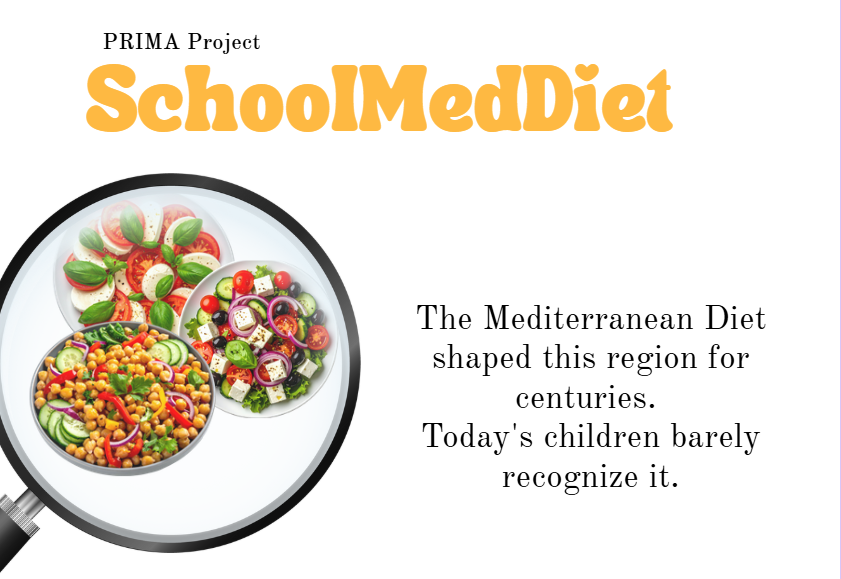
SchoolMedDiet: Living Labs bringing the Mediterranean Diet back to schools
The problem: Younger generations across the Mediterranean are drifting away from the traditional diet that once defined the region, with school food systems struggling to offer meals that are healthy, sustainable, and locally rooted.
The solution: Bringing students, families, teachers, and local authorities together inside school-based living labs, backed by virtual reality, and smarter food procurement, to make the Mediterranean Diet the default in school canteens and classrooms.
Schools are where food habits are formed, reinforced, or lost. SchoolMedDiet will intervene at exactly that level, establishing living labs in Greece, Malta, Morocco, and Tunisia, where students don’t just learn about good nutrition, they help design it. An AI-powered food assistant will provide personalised guidance, while immersive VR modules connect children to the food heritage behind the Mediterranean Diet. In parallel, the project will work with municipalities to reform how schools source and serve food: more seasonal, more local, less waste.
Why it matters: Telling children to eat better doesn’t work. Changing the environment around them does. SchoolMedDiet tackles the problem on three fronts: what students learn, what lands on their plate, and what policies govern school food procurement.
The expected impact: Over 1,000 students and educators will engage with innovative digital tools, showing measurable gains in Mediterranean Diet adherence, nutrition literacy, and sustainability awareness. Schools will reduce food waste and increase locally sourced ingredients. Beyond the pilots, validated procurement models, a cross-Mediterranean roadmap, and a replication toolkit will enable other municipalities to follow suit, scaling healthier, more sustainable school food systems across the region.
SCHOOLMEDIEDT is led by the University of Western Macedonia, UOWM – Greece
SHADES: Making sustainable, healthy eating the norm from the canteen to the kitchen table, across five Mediterranean cities
The problem: Across the Mediterranean, children and families are drifting away from a diet that is both a health asset and a cultural identity, while schools struggle to put genuinely sustainable, locally rooted food on the plate.
The solution: Turning schools into living labs for food system change, reforming what gets served in canteens, how children learn about food, and how families choose at home, across five cities reflecting the full diversity of the Mediterranean world.
From Milan to Chefchaouen, from Amman to Muratpaşa and Cornellà de Llobregat, SHADES will operate across five cities with different food cultures, institutions, and policy landscapes, and treats that diversity as a strength. In each, the school canteen becomes the strategic entry point: a place where procurement can be reformed to favour seasonal, local, and organic supply chains, meal design can reflect Mediterranean Diet principles, and food waste can be measurably reduced. But SHADES doesn’t stop at the school gate. A gamified app, interactive platforms for educators and families, and an AI-based dietary feedback tool extend the project’s reach into homes, reinforcing in the kitchen what is learned in the classroom.
Why it matters: Every school menu is a policy decision, about which farmers get supported, which foods become familiar, and which children grow up knowing what a seasonal, local meal looks like. SHADES will link urban food demand to rural supply, support women and youth producers, and embed change in participatory governance built with communities, not imposed on them.
The expected impact: Thousands of students, families, teachers, and canteen staff across five countries will engage with new digital tools, with dietary changes tracked via validated instruments. Schools will shift toward more seasonal, local, and organic procurement. A co-developed youth sustainability score will offer a new way to measure progress. Beyond the pilots, SHADES will deliver co-designed policy recommendations and a replicable governance model for both EU and MENA contexts, a scalable blueprint for making the Mediterranean Diet the norm, not the exception.
SHADES is Led by ENCO, srl – Italy.
——————————-
The Mediterranean Diet was never just a way of eating, and these four projects are proof that it still has the power to bring people, communities, and landscapes together.
Access the full campaign here:
The article in a nutshell:
- The UN has declared 16 November the first-ever International Mediterranean Diet Day, recognising it as a public health model, environmental asset, and UNESCO-protected cultural heritage.
- Despite this recognition, the Mediterranean diet is paradoxically disappearing from the region, displaced by ultra-processed foods, urbanisation, and changing lifestyles.
- In 2025, PRIMA launched a dedicated funding call to bridge the gap between what we know about the Mediterranean diet and what people actually eat, selecting 4 new projects: MED4CITRUS, PANACEA, SchoolMedDiet and SHADES.
- All four build on previous PRIMA research and tools, and share a common premise: information alone does not change behaviour,change requires meeting people where they live.
- Their approaches range from virtual reality and living labs to citizen science, targeting schools, maternity wards, citrus-growing communities, and urban populations across the Mediterranean.