Every year on March 22, World Water Day reminds us of water’s central role in sustaining life, livelihoods, and ecosystems.
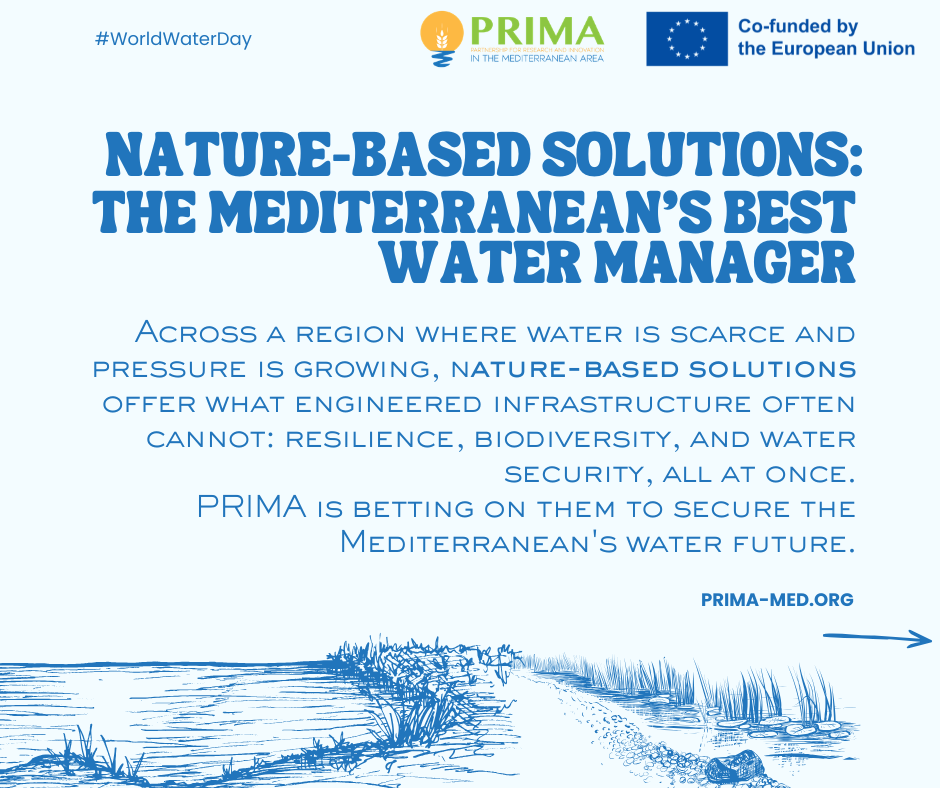
In 2025, PRIMA made a strategic choice. Rather than simply funding incremental improvements to conventional water infrastructure, we placed a deliberate bet on Nature-Based Solutions (NBS) as the cornerstone of our water management theme under the Water-Energy-Food-Ecosystems (WEFE) Nexus.
Why Nature-Based Solutions?
Nature has been managing water for millennia. Wetlands filter pollutants. Healthy soils absorb and store rainfall. Restored ecosystems regulate floods and recharge aquifers. These solutions don’t just address one problem, they deliver multiple benefits simultaneously: climate resilience, biodiversity restoration, improved food production, and stronger communities.
But despite their proven potential, Nature-Based Solutions have remained trapped at pilot scale. Evidence on their cost-efficiency and socio-cultural impacts has been fragmented. Holistic approaches for upscaling them across entire catchments have been lacking. And critically, there has been insufficient demonstration of how different types of NBS can be combined and integrated to tackle the Mediterranean’s interconnected water challenges, from salinity management and agricultural pollution to extreme weather events and coastal degradation.
PRIMA’s 2025 Call for Proposals on “Upscaling Nature-Based Solutions for Sustainable Water Management to Address Extreme Events in the Mediterranean” was designed to close these gaps. The call sought projects that would move beyond isolated demonstrations to prove that NBS can be scaled, replicated, financed, and governed effectively across diverse Mediterranean contexts.
Four projects were selected.
Today, on World Water Day 2026, we’re proud to spotlight these four initiatives: FLOW4Med, INVESTWATER, NBS360, and SIRENA.
FLOW4Med: Nature-Based Solutions across the water cycle
The challenge: Water scarcity, pollution, and ecosystem degradation across diverse Mediterranean landscapes
The solution: Context-specific nature-based interventions that restore ecosystems while securing water
Water problems look different everywhere, polluted rivers in Lebanon, degraded farms in Crete, overheated cities in Cairo. FLOW4Med wishes to tackle all three. The project demonstrates how nature-based solutions can be tailored to vastly different contexts: constructed wetlands that turn wastewater into safe irrigation water, regenerative farming techniques that make soil hold more water, and urban green infrastructure that cools cities while recycling greywater. By testing these approaches in real-world conditions across three countries, FLOW4Med proves that ecological restoration and water security can happen together.
Why It Matters: Most water solutions are either high-tech and expensive, or they only work in one specific setting. FLOW4Med shows that working with nature, not against it, can address multiple problems at once: pollution, drought, heat stress, and food production, all while restoring degraded ecosystems.
The expected impact: The project will provide ready-to-use blueprints for nature-based water management that Mediterranean communities, farmers, and cities can adapt to their own conditions. This means cleaner rivers, more resilient farms, cooler cities, and communities that can manage water sustainably even as climate pressures intensify.
FLOW4MED is a Section 1 PRIMA project led by Coordinator Boris Heinz (Technical University of Berlin, Germany).
INVESTWATER: making Nature-Based Solutions trustworthy and scalable
The challenge: Communities hesitate to adopt nature-based water solutions, they don’t know if they’ll work
The solution: Decision-support tools that prove how well these solutions perform before you invest
Nature-based solutions sound good in theory: wetlands that filter water, green infrastructure that captures rain, restored ecosystems that recharge aquifers. But will they actually work in your region, under your climate conditions, with your budget? INVESTWATER answers that question. The project builds digital tools that combine satellite data, climate projections, and physical models to predict how specific nature-based solutions will perform in specific places. Tested across four pilot sites in Cyprus, Portugal, Italy, and Tunisia, these tools don’t just demonstrate what’s possible, they give decision-makers the confidence to scale up what works.
Why It Matters: The biggest barrier to nature-based water management isn’t technology, it’s trust and understanding. Local governments, farmers, and communities need proof that these solutions deliver results before committing resources. Without that proof, even the best innovations stay stuck at pilot scale.
The expected impact: INVESTWATER will provide Mediterranean regions with validated frameworks to choose, finance, and implement nature-based water solutions that fit their specific conditions. This means faster adoption, smarter investment, and water management strategies that actually get deployed, not just demonstrated.
INVESTWATER is a Section 1 PRIMA project led by Coordinator Constantinos Panagiotou (Eratosthenes Centre of Excellence, Cyprus)
NBS360: a 360-degree innovation ecosystem that connects science, advanced digital tools, inclusive governance and sustainable financing
The challenge: Isolated pilots prove nature-based solutions work, but they never scale
The solution: A full 360-degree innovation system that connects science, digital tools, governance, and financing
Mediterranean water problems don’t exist in isolation, soil erosion feeds reservoir siltation, droughts alternate with flash floods, inefficient irrigation accelerates salinization. NBS360 tackles this complexity head-on. Across seven demonstration sites, the project will test integrated nature-based solutions that address multiple risks at once, then builds the complete infrastructure needed to scale them: real-time monitoring systems, a Digital Twin that lets communities simulate different scenarios before investing, financing mechanisms like Payments for Ecosystem Services, and participatory governance structures that give local authorities and farmers the tools to make informed decisions. This isn’t just another pilot, it’s the full support system that pilots have been missing.
Why It Matters: We already know nature-based solutions work in controlled settings. The problem is everything that happens after the demonstration: Who pays for long-term maintenance? How do you adapt a solution tested in Cyprus for use in Tunisia? Who makes the decisions, and are communities actually on board? Without answers to these questions, even successful pilots die on the vine.
The expected impact: NBS360 will provide Mediterranean regions with a proven, replicable model for turning nature-based water management from demonstration projects into functioning systems,complete with the digital tools, financial mechanisms, policy frameworks, and community ownership needed to sustain them for decades.
NBS360 is a Section 1 PRIMA project led by Coordinator Evangelos Tziritis(Ellinikos Georgikos Organismos – Dimitra, Elgo, Greece)
SIRENA: from demonstration to deployment at scale
The challenge: Nature-based water solutions remain stuck in pilot mode, and it’s challenging for them to reach full-scale deployment
The solution: Living labs that co-create, test, and scale solutions with communities, backed by digital tools and policy frameworks
Most nature-based solutions never make it past the demonstration phase. SIRENA changes that by building complete innovation ecosystems around six WaterMED Living Labs across the Mediterranean. These aren’t just test sites, they’re collaborative hubs where researchers, communities, policymakers, and practitioners co-design nature-based interventions to tackle droughts, floods, pollution, and biodiversity loss, then develop everything needed to scale them: participatory governance structures, AI-powered scenario modeling platforms, financing mechanisms, and policy recommendations. The project creates the Mediterranean Water Resilience Framework, a comprehensive toolkit integrating real-time environmental data, citizen science, and decision-support dashboards that help stakeholders select, implement, and sustain the right solutions for their specific conditions.
Why It Matters: We don’t lack effective nature-based water solutions, we lack the institutional capacity, governance models, digital infrastructure, and financing pathways to deploy them beyond isolated pilots. Without these enabling conditions, even successful demonstrations fail to achieve systemic change.
The expected impact: SIRENA will provide Mediterranean regions with a proven model for moving nature-based solutions from concept to widespread adoption, complete with the participatory frameworks, digital tools, policy roadmaps, and multi-stakeholder engagement strategies needed to make water resilience a practical reality, not just an aspiration.
SIRENA is a Section 1 PRIMA project led by Coordinator Simos Malamis (National Technical University of Athens, NTUA, Greece)