[PRIMA summer story] | For centuries, the Mediterranean has been a land of storytellers. Long before words were written down, stories were passed on by word of mouth, around a fire, from one generation to the next, before they were etched onto papyrus, carved into stone walls, or carried through symbols and myths that have travelled across ages. It is a culture shaped by narrative: by the ability to turn a complex reality into a story that can be understood, remembered, and passed on. Today, that tradition is reinventing itself. Mediterranean stories are no longer told only through words or carved symbols, but also through scientific data, years of research, maps, and the technology needed to bring them to life. From this convergence of narrative heritage and modern science, new tales are born: water tales that relay the story of memory and measurements, observations and analyses.
What if you could see the Mediterranean’s water challenges, not just read about them?
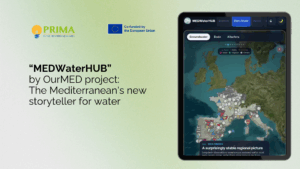
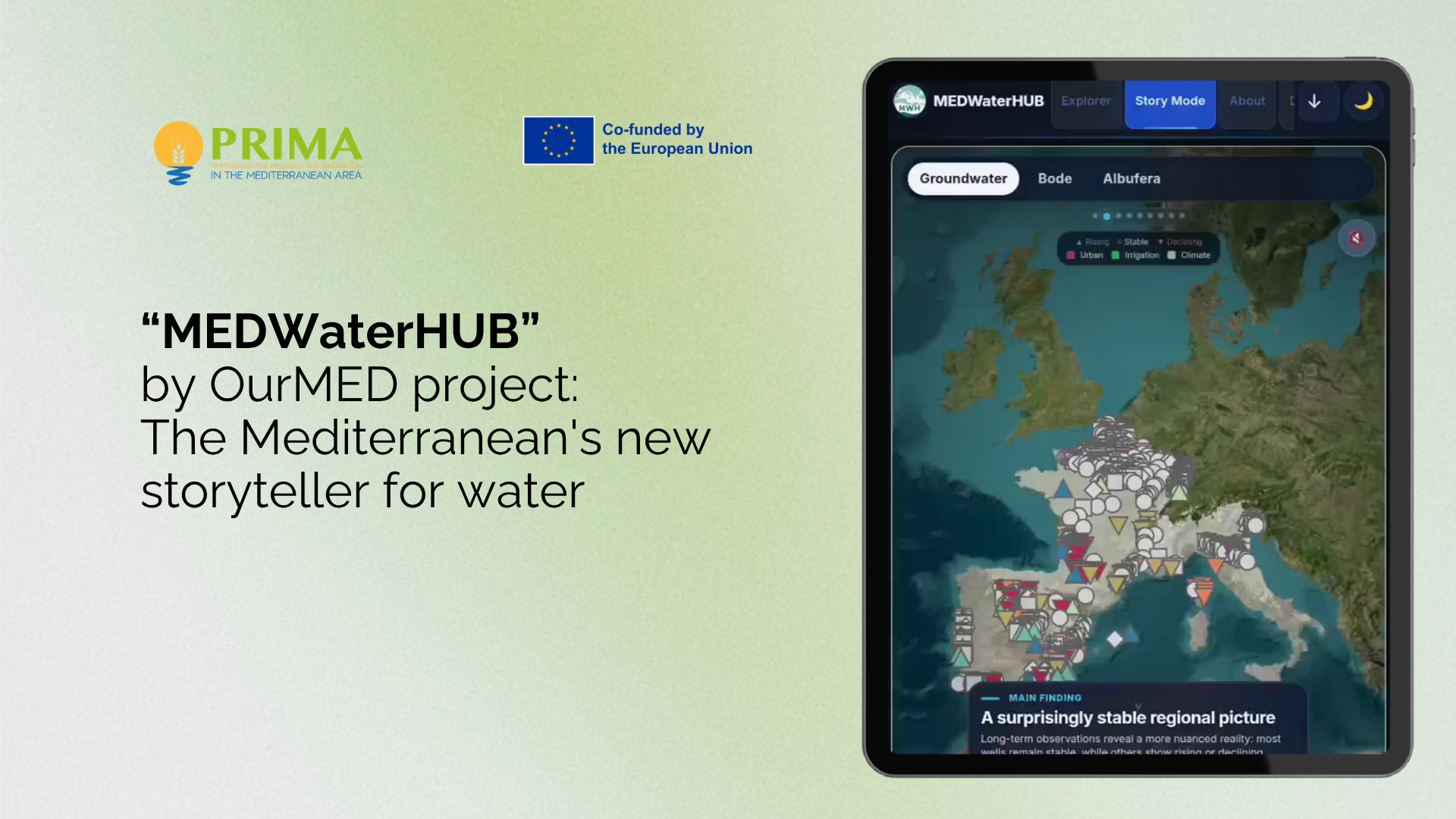
That’s the question behind MEDWaterHUB , a new cloud-based platform, unveiled at the Sustain Tunis 2026 Conference this past June and launched by the PRIMA OurMED project, coordinated by Dr. Seifeddine Jomaa (UFZ).
As stated in MEDDWaterHUB’s Sustain Tunis 2026 Conference abstract: “The Mediterranean region is increasingly exposed to water stress due to climate change, population growth, and unsustainable resource management. Despite the availability of numerous water-related datasets, these data remain highly fragmented, heterogeneous, and difficult to access or interpret, limiting their usefulness for decision-making and public awareness.”
“MEDWaterHUB was built to close that gap”, says UFZ hydrologist and OurMED project coordinator Dr. Seifeddine Jomaa.
One hub, two ways to explore
MEDWaterHUB centralizes climate, hydrology, groundwater, and socio-economic indicators from across the Mediterranean into a single interactive, map-based platform. It currently offers two modes:
Explorer Mode lets anyone navigate years of environmental data through interactive maps and dynamic visualizations, spatial and temporal patterns, key indicators, and regional water challenges, no technical background required.
Storytelling Mode is where the “water tales” come to life.
Why storytelling matters as much as the data itself:
Raw datasets rarely change minds or shape policy on their own. A spreadsheet of groundwater measurements means little to a policymaker or a citizen unless it’s translated into tangible information they can understand and act on. That’s the core conviction behind MEDWaterHUB’s storytelling approach: pairing rigorous data with guided narratives that make complex environmental phenomena legible to non-specialists.
“As scientists, we should really understand the importance and power of storytelling. It should be part of project outputs. We need to understand its potential and utilize it“, says Seifeddine Jomaa. He also points to the bigger picture behind the numbers:
“Monitoring is essential and should integrate multiple data sources, including Earth Observation, to identify when a system is at risk. However, effective action also requires social readiness, supportive policy, and a financial sector that understands and responds to these risks and translates them into opportunities.”
Three stories:
Three stories are live on the platform at launch, each anchored in recent research and real places:
- Groundwater Under Pressure: A study across Southwestern Europe overturns a common assumption: groundwater isn’t declining everywhere. In fact, 68% of wells examined stayed stable over three decades, and 20% even increased. The 12% that did decline were concentrated in semi-arid, intensively farmed regions and water-hungry cities, a nuanced, evidence-based picture that reframes how groundwater should be managed as a strategic reserve in a stressed region.
- Focus on the Bode River Basin (Germany): A ~3,300 km² catchment connecting mountain headwaters, farmland, and drinking-water infrastructure, told through a digital-twin lens that shows how droughts and deforestation ripple through a tightly linked water system.
- Focus on the Albufera Lake and the Silla Constructed Wetland (Spain): Near Valencia, one of the Iberian Peninsula’s most valuable freshwater ecosystems is showing visible signs of stress, including a 2023 “brownification” event driven by drought and heat. The story follows a nature-based solution in action: a 1.2-hectare constructed wetland intercepting polluted flows before they reach the lake, with monitoring showing strong nitrate reduction along the way.
Each story walks the visitor from problem definition, to evidence, to concrete solution, designed so that anyone, not just experts, can follow the thread and grasp what’s really at stake.
A Platform built on years of collaboration
MEDWaterHUB represents the accumulated output of years of cross-project collaboration in the Euro-Mediterranean research community, alongside OurMED stand Sustain-COAST, InTheMED, MEDSAL, INTEL-IRRIS, RESILINK, NATMed and SALAM-MED.
The groundwater story, for instance, brought together OurMED with two other PRIMA-funded projects, Sustain-COAST and InTheMED.
That spirit of synergy runs through OurMED more broadly. The project also co-initiated NEXTGEN4MED, a youth-driven initiative launched together with two other PRIMA projects (NATMed and SALAM-MED) to equip early-career researchers and young professionals with the tools and networks to become the next generation of Mediterranean water leaders.
An open call: help build the next chapter
MEDWaterHUB is described as “a small demo with a big ambition.” The team behind it is now opening the platform up:
- Feedback is welcome: the project wants to hear from users on how to improve the platform and the hub experience.
- Researchers and scientists are invited to propose new stories: if you have data and findings from your own work that could be translated into a MEDWaterHUB narrative, the team is offering support to help develop it.
The long-term vision is a genuinely collaborative hub: a space where people don’t just read, learn, and interact with existing content, but also contribute their own stories, grounded in their own research and data.
Explore MEDWaterHUB, dive into the stories, and if you’re a researcher with a story to share, get in touch write them at [email protected].
OurMed is a PRIMA Section 1 project led by Seifeddine Jomaa (Helmholtz Centre for Environmental Research (UFZ), Germany, bringing together a multidisciplinary consortium of 14 partners from 10 Mediterranean countries. The consortium includes Remote Sensing Solutions GmbH (RSS GmbH) in Germany; the Polytechnic University of Valencia (UPV) and Global Omnium Idrica (IDRICA) in Spain; the Euro-Mediterranean Information System on Know-how in the Water Sector (SEMIDE) and Tour du Valat (TdV) in France; the Technical University of Crete (TUC) in Greece; the University of Parma (UNIPR), the University of Sassari (UNISS), and the University of Naples Federico II (UniNa) in Italy; the Royal Society for the Conservation of Nature – Azraq Wetland Reserve (RSCN-AWR) in Jordan; Living Planet Morocco (LPM) in Morocco; AgroInsider (AGRI) in Portugal; the Higher School of Engineers of Medjez El Bab (ESIM) in Tunisia; and Boğaziçi University (BOUN) in Türkiye.