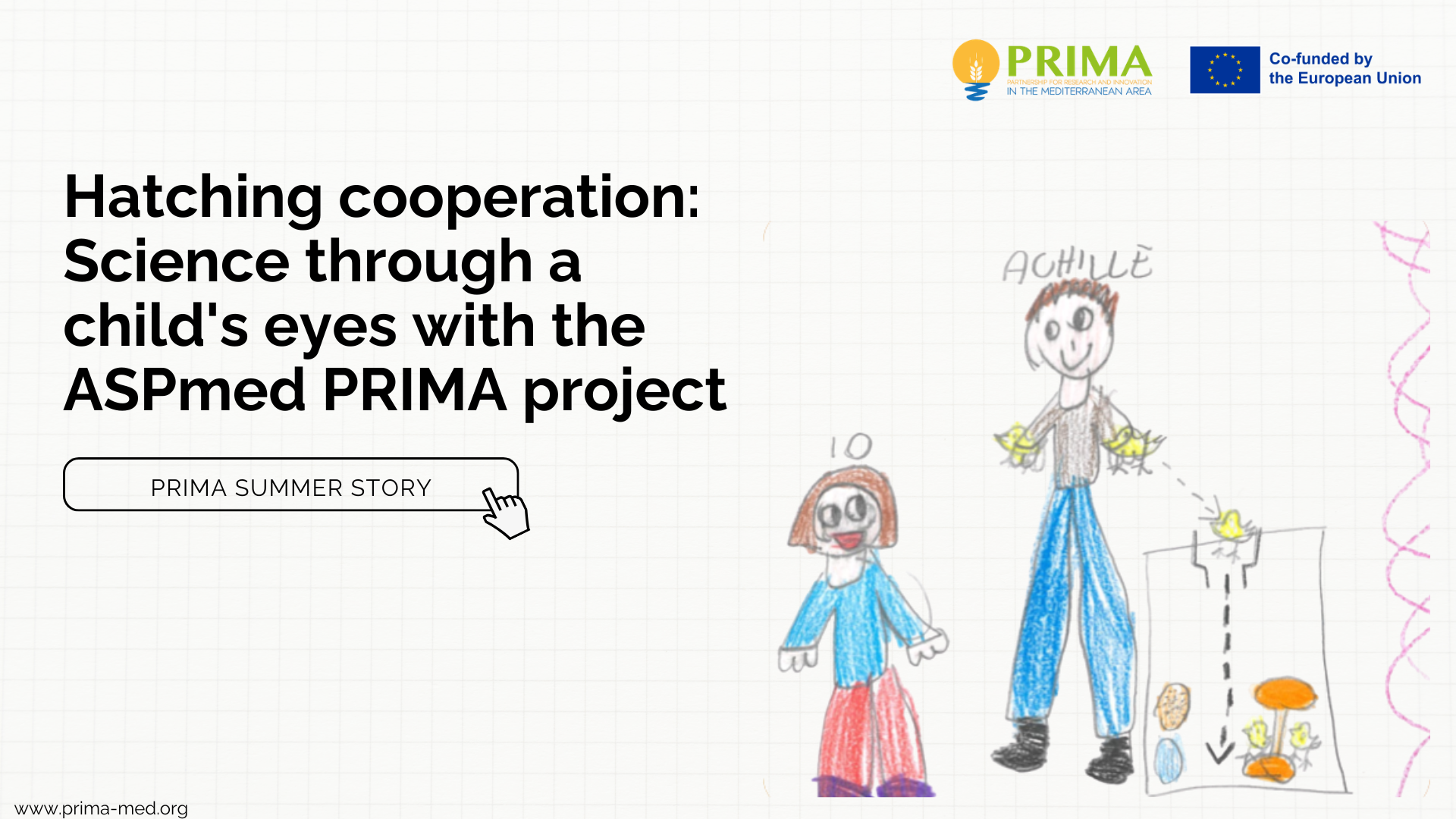
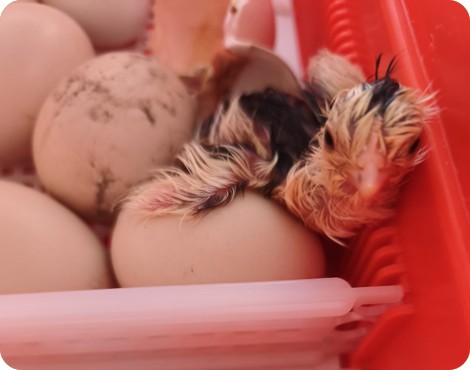
[PRIMA SUMMER STORY] A chick hatching in a classroom in Italy. A European project being born at the University of Turin. Two births that are really just one story: the story of ASPMED, that Prof. Achille Schiavone (University of Turin – UNITO), Coordinator of the PRIMA ASPmed project, and Dr. Marta Gariglio (Researcher at the Department of Veterinary Sciences – Poultry Science) suggested at the very beginning of their project: to go further than deliverables and outputs alone, building, together with children, farmers and communities, the foundations of research.
There is something poultry scientists observe between 500 and 1,000 times a year. Something so ordinary they forget about it. Something that many people, young and old, have never truly experienced in their lives: the birth of a chick.
It’s this simple, natural thing, part of our life systems, that Prof. Achille Schiavone, coordinator of the ASPmed project, together with Dr. Marta Gariglio (University of Turin), decided to bring back into classrooms. Doing so, they also brought to the class the birth of a new international project.
When Achille and Marta kick-started ASPmed, a PRIMA project aiming to reduce the environmental impact of poultry and sheep farming systems while improving animal welfare, they immediately had a shared idea, based on past experience: bring this European project right into the classroom, across four second-grade classes (7-8 years old).
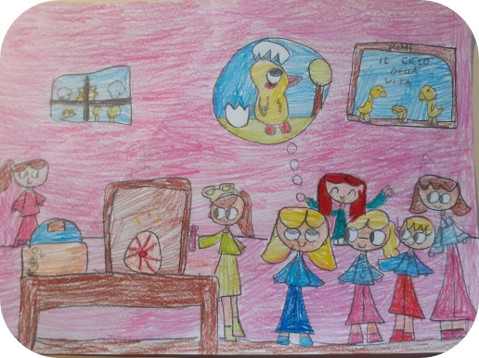
FROM THE CLASSROOM TO THE FIRST TEAM MEETING
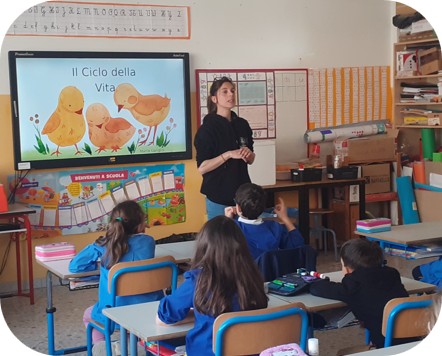
Four workshops were organized. Four moments where science and nature met within the walls of schools.
Workshop 1 – Incubation: With Marta and Achille, the children observed eggs. They learned the difference between a fertilized egg and a commercial one. Incubators were installed in each classroom. Fertilized eggs from local breeds began their 21-day wait.
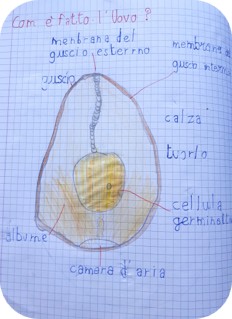
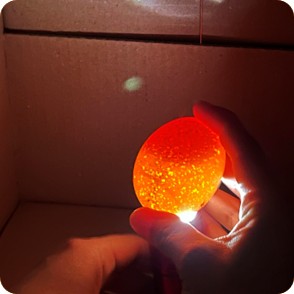
Workshop 2 – Candling: The stages of embryonic development were explained. The children saw through the shells, literally, the transformation taking place. The invisible becoming visible.
Workshop 3 – Hatching: The day of birth. The children watched the chicks hatch. They discovered imprinting. They learned about chick sexing. And above all, they experienced something that can’t be learned from a book: waiting, patience, the frustration of a natural process that takes its own time, and that can also end unexpectedly.
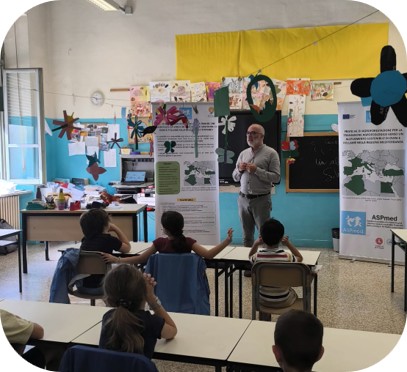
Workshop 4 – ASPMED: Finally, the project itself was presented. Agroecology. Sustainability. Animal welfare. The children were no longer just watching eggs, they understood why it all mattered.
This was also the moment to explain what an international project was, pointing on a map to all the countries and the different teams that would be involved in the project. In the case of ASPmed, 8 countries from all around the Mediterranean are involved: Italy, Croatia, Algeria, Egypt, Spain, Portugal, Türkiye and France.*
WHAT CHANGED
The teaching staff noticed something. “It’s interesting,” Achille reports. “We received a lot of feedback from the teaching teams about how the children’s behavior was changing over the course of these sessions.”
It wasn’t just academic interest, but something deeper. A reconnection with wonder. With the living world. “We noticed a strong interest from the children as soon as we spoke to them, showed them the eggs, the different processes. We noticed a growing interest in science, in their environment.”
And here is what perhaps struck the scientists themselves the most:
“Working alongside animals has an impact on young people, but also on adults. We noticed the same interest, the same patience and the same wonder in some of the parents and teachers. Everyone connects when it comes to seeing natural processes with their own eyes.”
“As scientists, it’s sometimes good to reconnect with that sense of wonder,” Marta says.
FROM THE CLASSROOM TO THE UNIVERSITY OF TURIN
On June 30, 2026, in the Aula Magna of the University of Turin (which has witnessed science since 1404) the project’s partners gathered and met for the first time. It was supposed to be a standard in person meeting: work packages review, timelines, responsibilities, budget and deliverables.
But the coordinators came up with another idea, to keep the relationship with the kids and schools active. They invited the children and they invited the farmers they’ve worked with for years, who supply them with the eggs. They created an encounter between stakeholders. Children mingling with the farmers who’d been invited. Teachers talking with international partners.
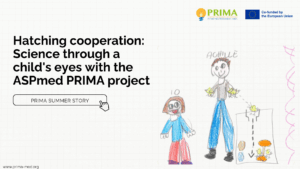
A great occasion to create four posters covered in the children’s drawings, displayed as though they were scientific posters.
The posters colored the meeting, putting something essential back at the heart of the gathering: the project rooted in its communities, not just among the partners, but among all the necessary stakeholders: farmers, rural communities, citizens, and future citizens: the children. One invited farmer said something to Achille that sums it all up: “Above all, thank you for making sure we are protagonists, not just spectators, of what you’re going to do in this project.”
WHAT’S ALREADY INSPIRING OTHERS
Long-term work with schools, dedicated time: this gave the project real momentum from the start, an energy that has inspired other partners, most of it in Algeria, in Tükyie. Other institutions and partners are now talking about involving rural communities, inspired by these examples.
By rooting the project in wonder, in direct learning from nature, in the practice of putting oneself in someone else’s shoes and seeing situations through a child’s eyes, they built solid foundations for what research can become. And that, fundamentally, is what makes a PRIMA project: the commitment to seeing things differently, finding solutions together, and listening to every voice, as the living practice of how science and innovation actually happen.
————————————-
More about the project:
ASPmed aims to reduce the environmental impact of poultry and sheep systems while improving animal health and welfare. The project strengthens biodiversity, ecosystem services and rural resilience, with a strong focus on gender equality and women empowerment.
ASPmed develops innovative agroforestry tools and tests novel feeding and management strategies. Monitoring technologies and pilot demonstrations validate best practices in real farming environments, creating practical and scalable solutions adapted to Mediterranean contexts.
Link: https://www.aspmed.eu/home
*ASPmed is a PRIMA Section 2 project, coordinated by the University of Torino (UNITO) alongside 9 partners: University of Florence – UniFi (Italy), University of Murcia – UMU (Spain), Instituto Politécnico de Viana do Castelo – IPVC (Portugal), Ege University – EGE (Türkiye), International Agricultural Research and Training Center – UTAEM (Türkiye), Cairo University – CU Egypt (Egypt), Université d’Oran 1 Ahmed Ben Bella – UORAN1 (Algeria), University of Zagreb, Faculty of Agriculture – UNIZG-FoA (Croatia), and French National Research Institute for Agriculture, Food and Environment – INRAE France (France).
This project is part of the PRIMA Programme, supported by the European Union. Funding is provided by the following national funding agencies:: Ministero dell’Istruzione, dell’Università e della Ricerca – MIUR (NA) Agencia Estatal de Investigación (AEI)- State Research Agency – AEI (NA) Foundation for Science and Technology – FCT (NA) The Scientific and Technological Research Council of Turkey – TUBITAK (NA) Academy of Scientific Research and Technology – ASRT (NA) General Directorate for scientific research and technological development – DGRSDT (NA) Ministry of Science and Education – MSE (NA) Agence Nationale de la Recherche – ANR (NA).