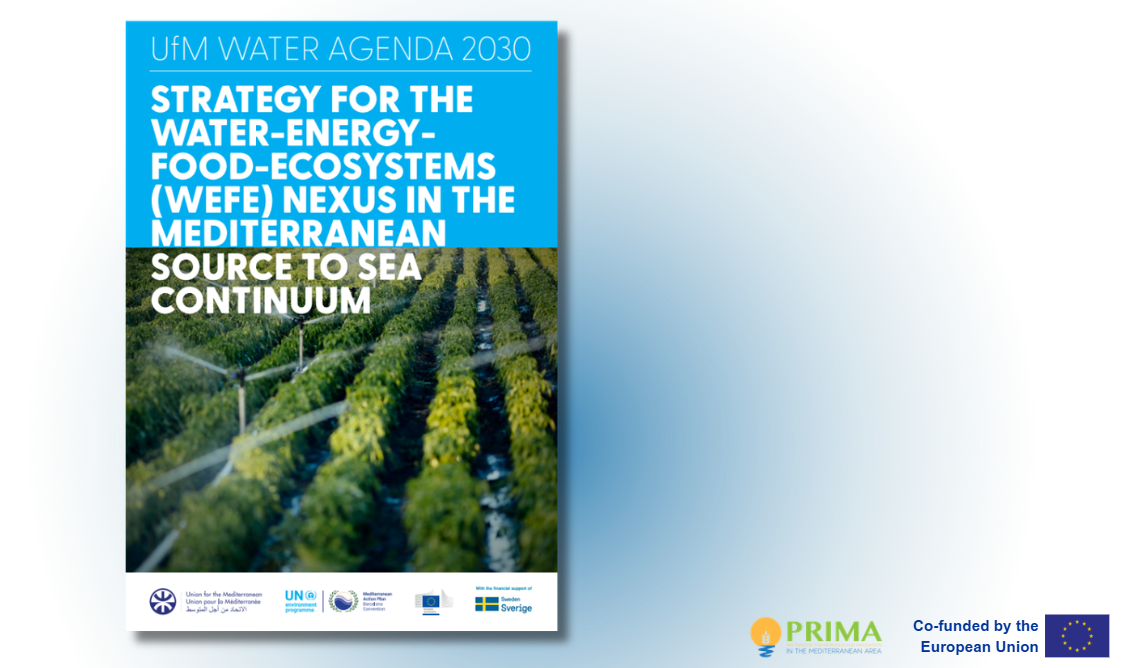
- The Mediterranean WEFE Nexus Strategy in the Source-to-Sea Continuum has been published, and PRIMA is at its heart.
- The final Strategy was adopted by the Barcelona Convention COP24 (held in Cairo, December 2025) and by the 15th Meeting of the UfM Regional Platform on Water (held in Barcelona, November 2025)
- Strategic objective: moving from “Nexus thinking” to “Nexus doing.”
- Key partners: led by the Union for the Mediterranean, the European Commission, and UNEP/MAP, with technical support from GWP-Med, EU-funded WES project, and PRIMA.
- A pioneer since 2019: PRIMA has funded 12 dedicated WEFE Nexus projects (€34M), and following the mainstreaming of the Nexus across all its calls in 2024, a further 67 projects integrating the Nexus approach are now entering the PRIMA portfolio, mobilising €114M in research and innovation investment across the region.
- The Strategy and its Action Plan will pave the way for scaling up PRIMA projects, offering completed projects a concrete pathway, through this regional framework, to move from pilot to scale.
Read & Download the strategy on UfM’s website: https://ufmsecretariat.org/publication-speech/wefe-nexus-strategy/
From concept to commitment
For years, the Water-Energy-Food-Ecosystems (WEFE) Nexus has offered a framework for thinking about these interdependencies together rather than in isolation. But thinking is not enough. The Mediterranean needs action: coordinated, evidence-based, and scalable.
That vision was captured with particular force at the Regional Conference on Water-Energy-Food-Ecosystems Nexus in the Mediterranean Source-to-Sea Continuum: From Strategy to Action, held under the auspices of the Cyprus Presidency of the Council of the European Union (24–26 February 2026). Speaking at the conference, PRIMA’s Director Octavi Quintana put it this way:
“When we speak about the Mediterranean, we often speak about history, culture, and shared identity. But today, I invite you to think of the Mediterranean not only as a sea, but as a living system. A drop of water that falls on a mountain in the Atlas, the Alps or the Levant does not stop at a border. It travels through soils and aquifers, feeds crops, sustains cities, cools power plants, nurtures wetlands, and eventually reaches the sea. Along its journey, it connects farmers, engineers, entrepreneurs, scientists, policymakers, and communities. It connects water, energy, food, and ecosystems. This is the essence of the WEFE Nexus.“
The WEFE Nexus Strategy in the Mediterranean Source-to-Sea Continuum marks a decisive moment for the region. Developed by UfM and the European Commission in partnership with GWP-Med, UNEP/MAP MedProgramme, and PRIMA, this Strategy provides a shared framework for translating Nexus principles into governance, planning, and investment, from mountain ranges to coastal waters, across borders and sectors.
PRIMA’s role: from science to action
As one of the first initiatives in the Mediterranean to operationalise the WEFE Nexus, PRIMA launched its first dedicated Nexus call as early as 2019, focused on building the science, developing the tools, and deepening understanding of the interconnections between water, energy, food, and ecosystems. From there, PRIMA moved deliberately toward innovation actions, demonstration sites, and governance pilots, because evidence must be visible and tested in real conditions before it can change policy.
Over the years, PRIMA-funded projects have generated exactly that kind of evidence. Through demonstration sites, nature-based solutions, digital platforms, participatory governance approaches, and modelling tools, they have shown that integrated solutions are not only more sustainable, they are more resilient and more cost-effective than siloed approaches.
PRIMA also invested in building a Mediterranean WEFE Nexus Community of Practice, creating a space where projects connect, where practitioners and investors engage, and where policy coherence can grow across sectors and across countries.
Today, the WEFE Nexus is no longer a dedicated topic within PRIMA’s calls. It is embedded across all of them, in water management, in farming systems, in agri-food innovation. It is PRIMA’s guiding principle, and it is becoming the backbone of the organisation’s future Strategic Research and Innovation Agenda under Future4PRIMA.
PRIMA projects: the operational pillar of the Strategy
The relationship between PRIMA and the Strategy is not one of alignment, it is one of integration. The Strategy explicitly recognises PRIMA-funded projects as one of its key operational pillars, delivering the action component on the ground that transforms vision into practice.
Where the Strategy sets direction, PRIMA projects deliver results: tested solutions, measured outcomes, and built capacity. They demonstrate what integrated water-energy-food-ecosystem management looks like in practice, across the diverse contexts of the Mediterranean, from North Africa to Southern Europe, from arid lowlands to mountain watersheds.
As the region now faces the challenge of scaling up from pilots to systemic change, PRIMA is uniquely positioned to support that transition. It brings together the scientific community, national funding agencies, policymakers, and innovators around a shared agenda. It has the track record, the networks, and the tools to mobilise investment in integrated solutions, and to make the business case for doing so.
Taking concretisation further: the WEFE Online Tool
Moving from strategy to implementation also requires the right instruments. PRIMA Project officer, Prof. Ali Rhouma, has taken a significant step in that direction by developing the WEFE Online Tool, to track water, energy, food, and environmental indicators with a step-by-step workflow based on the official methodology.
The tool integrates the Resource Nexus Identification Tool, allowing to evaluate projects and/or proposals through a structured 9-step process that supports project developers, policy makers, and investors in assessing alignment with the Nexus approach.
It provides a systematic framework for reviewing project proposals and identifying opportunities to strengthen the integration of Resource Nexus principles. By progressing through each step, stakeholders can better understand how a project affects different resources, identify trade-offs and synergies, and promote investments that deliver sustainable, cross-sectoral outcomes. In this way, the Tool fosters more informed decision-making and helps align projects with WEFE Nexus principles.
>> https://wefe-tool.online/resource-nexus
This work is also documented in a peer-reviewed publication:
📄 Rhouma, A., Antonella Autino, A., Fabio Maria Montagnino, F. M., Anna Malagòó, A, Davide Dallera, Giovanni Bidoglio, G., & José María Gil López. (2025). A novel tool for translating Research and Innovation project outputs into measurable contributions to the UN Sustainable Development Goals. Environmental Science & Policy, 174, 104284. linkinghub.elsevier.com/retrieve/pii/S1462901125003004
Looking ahead
The publication of the Mediterranean WEFE Nexus Strategy is a milestone, but it is also a starting point. The real challenge now is investment, coordination, and scale. Financing for integrated projects remains constrained, in part because the benefits they generate across sectors are difficult to quantify with existing tools and metrics.
Addressing that challenge is where PRIMA’s role becomes most critical. As the region’s principal platform for research and innovation in the Mediterranean, PRIMA will continue to generate the evidence, build the capacity, and convene the partnerships that make integrated Nexus solutions investable, replicable, and lasting.